


I lived in an odd corner of the Docklands for quite a few years (sort of by accident), and ended up loving its weird futuristic/decaying wide-openness. For all the more conventional bits of East London I’d lived in during the preceding years, it was in the Docklands I ended up with a proper ‘local’ (the magnificent HUSK brewery, which to my delight is not only still going, but has upgraded to bigger and better premises), friendly neighbours - even an allotment at one point (sure, you had to cycle across what was essentially a motorway to get there - but that’s just the Docklands, baby! You’re gonna be cycling across a few motorways, and that’s just how it is). It was whilst living there - and reporting another piece, a feature about the past and future of E Pellicci, the historic family-run Italian café in Bethnal Green - that I heard about the New Docklands Steam Baths, the last vestiges of London’s working mens bathhouses, a volunteer-run space in the depths of what was, even for me, the middle of nowhere (apologies to the residents of Star Lane, whoever you might be, but you’re presumably terrifying). So I dropped by, and was overwhelmed by the vibrancy of the place. And I got chatting to a man named Wayne Gruba, who was the manager, and he paved the way for me to come back, meet the regulars, and experience my very first ‘schmeissing’ (and my subsequent twelve or so, for that matter). A few years later, after covid, I went back - and discovered to my sadness that Wanye had died. But the baths, which he did so much to preserve, are still going strong.
In the changing rooms at the New Docklands Steam Baths, a man I’ve just met is cracking my neck and spine. “Relax…no, properly relax,” says Lou, a heavy-set man of 69 with a faded tattoo of a mermaid on his forearm. CRACK. My neck jolts to the left, and then the right. I feel a chiropractic release. “That’s called the bear hug! I could see from how you moved your shoulder that you needed that. Right, I’m off, but I’ll see you around - I come here Sundays and Thursdays!” It’s a Tuesday evening. “Enjoy the schmeiss!”
*****
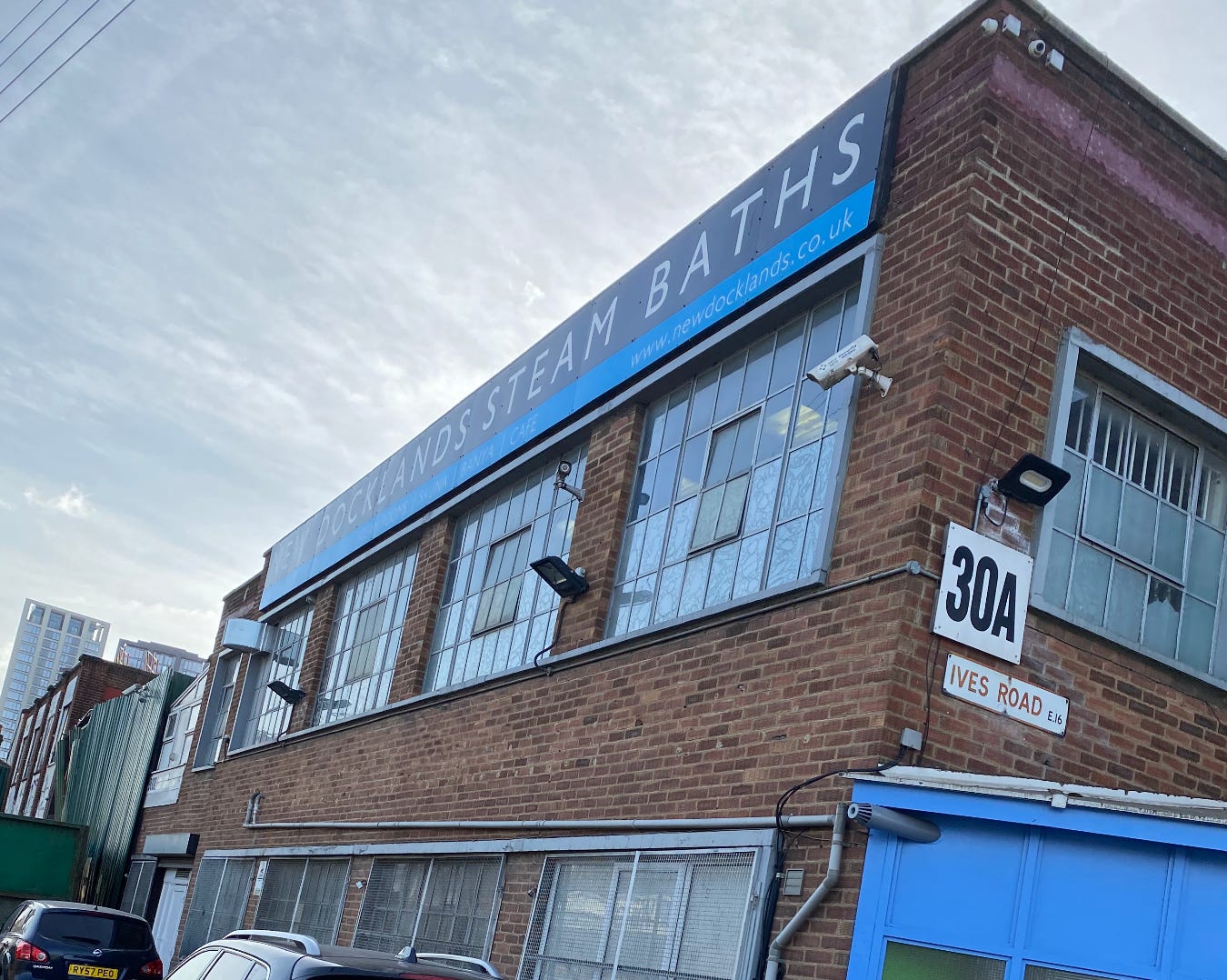
The last of East London’s traditional steam baths is located in a squat, flat-roofed unit in a grey, unlovely industrial estate on the edge of Canning Town. It is attended by what is surely a uniquely eclectic cross-section of society. Old East End cockneys. Young Russians, Lithuanians and Latvians. Hassidic Jews from Stamford Hill. Muslim students. Second generation West Indians. Boxers, opera singers, market traders, high court judges, nurses, night club owners, electricians, and at least one bank robber. It is predominantly – although not exclusively – a male space (there are mixed-gender sessions twice a week, and women-only sessions on Wednesdays). The nudity is relaxed and ubiquitous, and the fraternal, homosocial chatter throughout the rooms of the bathhouse is lively, unguarded, and uncensored.
I find the experience overwhelming at first - travelling from the changing rooms, through the quiet upstairs café, and down into the raucous, chattering bath house. But, over repeated visits, I begin to make sense of it. There are saunas of varying heats, from lukewarm to close to unbearable, where massages are given. There is the dense smog of the steam room, in which soapy raffia schmeissing mops (‘besoms’) are swung overhead and slapped downwards, cleansing and exfoliating the bodies of prone schmeiss-ees. There is the dark molten air of the Banya, whipped ever hotter by leafy venik branches wielded by Russians in pixie caps, seemingly impervious to the heat. Outside, there is the icy plunge pool. All treatmants are administered free of charge, by the bathhouse regulars, to one another. People stay for hours, shvitzing (sweating), showering, submerging themselves in the icy water, and then doing it all again.
“Your body ain’t fully clean unless you’ve been to the baths!” says retired cabbie Sammy Soraf, 91, still a Tuesday morning regular, who claims a Zelig-like series of associations across the 20th century, including dealings with the Krays, George Best, and Frank Sinatra. “There’s something ancient about a place like this,” says David Benson, 58, an actor, and creator of a series of one-man shows including an acclaimed portrayal of Kenneth Williams. “In the first place, it’s a ritual,” says Mark Lazarus, 81, a former professional football player for QPR who now runs a removals company in Romford. An East End Jew and one of 13 siblings (including Lew and Harry, both boxers, and Jojo, about whose colourful career no-one will speak on the record), Lazarus is former chairman of the Steam Baths - as the building’s current manager, Wayne Gruba, 65, explains to me. Gruba, who is bald, ursine and softly spoken, has run the New Docklands since 2000, and I find him in the café, reclining in swimshorts on a chair.
“When they shut the old East Ham Town Hall baths in the early Nineties it was still very busy”, explains Gruba, “but only about 30 people would pay legit. There was a back door, and a bloke who worked there opened it - about 180 people would come the back way.” Eventually the council closed the premises, and awarded the contract to collect the scrap to an East Ham customer - Dave Ames, a man the New Docklands regulars unanimously refer to as Pikey Dave. “Well Pikey Dave, he went and collected the boiler, the pipe works, the seating, the hooks,” says Gruba. “And a group of us regulars, we found this disused building [in Canning Town], broke in, and changed the locks. And we set it up! It was makeshift, but we had the steam.”
The regulars all invested some money in this first iteration of ‘Pikey Dave’s steam club’, which opened in 1995, with Mark Lazarus named chairman. “Our place was lively,” says Gruba, “and it was full of East Enders, who loved an ‘earner’. So there’d be all sorts of deals; stolen towels, razor blades, shampoo…” Ames couldn’t read or write, however, and his wife June handled the finances - but following her death in 1998, two years of disastrous financial mismanagement followed, with money being stolen by a series of duty managers. In 2000, following an emergency meeting, Mark Lazarus handed the reins, and the debt, to Gruba (whose background is in facilities management) on the proviso that he never let the baths shut. Gruba, a man who appears to take his responsibilities seriously, set about writing off the debts, and, in 2003, reorganised the New Docklands as a charitable trust.
“We’ve realised there’s a benefit to both schmeiss and venick, so our next step is to make that a part of coming here; if we could offer them as treatments, it would be a more well-rounded experience.” Gruba is constantly mindful of the need to expand the building’s appeal. When Eastern European customers started coming in 2009, he added the venik branches to the banya. He’s started teaching a masterclass on schmeissing, introducing younger generations to the rejuvenating pleasures of the soapy mop. “And we’re gonna get on social media, too…” But well as modernising, Gruba is tasked with preserving the heritage of the place, and managing the bickering, swearing old guard, with all their tall tales and eccentricities. “So there’s Lou, for instance, who has this thing where he likes clicking people’s backs.” I mention that I’ve met Lou. Gruba winces. “I keep telling him he shouldn’t be doing osteopathy, he’s a crane driver.” He shrugs. “But so far, touch wood, no-one’s been badly hurt.”
****
In my visits to the New Docklands Steam Baths, I’ve become fascinated by the interplay between the regulars. It’s a place of coarseness and vulgarity - of cackling, abuse, wilfully offensive swearing - but also of great tenderness. In a bath house with almost no staff - it’s just Gruba, really, with another person at the till and a café worker cooking food - there is a unique micro-economy of favours and kindness; massages are given freely, but with the expectation of one in return, at some point down the line. ’You scratch my back and I’ll scratch yours’ has never been interpreted more literally.
Everything about the experience is intense - the temperatures, the sensations, and the immediacy of human contact; without phones, or newspapers, people simply talk to one another. It’s odd, in the modern world, and especially in London, to be in an environment where people are genuinely relaxed, and open to conversation. Most co-working spaces or members’ clubs, ostensibly spaces for mingling, and theoretically conducive to impromptu deals being struck and creative sparks flying, in fact simply create little bubble worlds; hundreds of hermetically sealed ecosystems, comprised of flickering screens and headphones. At the baths, in amongst the shouting and the bullshitting, I am immediately and unconditionally welcomed by everyone I speak to. One evening in the café I get talking to Ben, 33, and Isaac, 35, two Stamford Hill Hassidim, who immediately offer me a glass of their vegetable juice as Ben shares his memories of visiting the baths with his father from the age of 15. Upon hearing that I’ve not yet been schmeissed today, Isaac heads back downstairs with me, sources a besom (from Syed Rahman, 24, a young Muslim student of Building Surveying at Westminster University, and one of Gruba’s schmeissing disciples), and selflessly scrubs my back - the third treatment he’s administered that day. And on my very first visit, David Benson the actor gives me a tour of the baths and warmly introduces me to everyone he passes, animatedly discussing his love for the New Docklands - “I escape from everything, it’s another world” - but ending on a note of particular distain for the councils who have made the place a necessity. “I always say that they’re like the Taliban - they shut everything down.”
London was once home to an array of municipal baths, where dockers would sluice off after a day’s work. Mile End. Hackney. Barkingside. York Hall. Ironmonger Row. Crisp Street. East Ham. All are now gone. “What you’ve got to remember,” says Malcolm Lanceman, 71, “is that people then just did not have bathrooms!” Malcolm, a retired finance professional, is part of the old guard - he was an original shareholder in Pikey Dave’s baths, before Gruba took over - and he still comes regularly, driving down from Harpenden to meet with a regular group including ‘Turkish Jock’, 68, a retired electrician from East London, and ‘Yorkie’, 76, a builder originally from Pontefract.
Each week they have a steam, then go for a curry, and share memories of regulars who have died - inhabitants of a London that’s fading away. Of Titch, the Jewish rag ’n’ bone man who taught Malcolm how to schmeiss, and who refused to go to war due to his strident socialist beliefs. Of Solly, who was released from prison on a Friday and somehow opened a pub on the Monday. Of Cyril, the immaculately-dressed taxi driver, who always arrived wearing a flawless suit and trilby. Of the beloved Bobby Lazarus, another of Mark’s brothers, whose life is commemorated by a gold plaque on the café wall, depicting his Rolls Royce, a winning hand of cards (his favourite pastime), and accompanied by a poem;
You always had a smile to share,
A laugh, a joke, time to care,
You left a place no one can fill,
We miss you Bob and always will,
Always in our hearts,
From your friends at the baths.
- Bobby Lazarus (1937 - 2002)
The glossy, glassy, world of modern London is creeping across the capital. The facilities on offer at the New Docklands have been repackaged and commodified elsewhere, for a very different market. Porchester Hall in Bayswater, once the only other equivalent space in the city, now charges £31 for two and a half hours’ entry. (“And there’s no canteen, no schmeissing, no venik, and you’re not allowed to shave,” says Gruba.) The Banya No. 1, in Hoxton, charges £60 for three hours (£75 at peak time). And at the Russian Bathhouse in Belgravia, the Standard treatment costs £90. The New Docklands Steam Baths costs £16 for a full day’s entry1. “It’s a dying trade, as it happens,” says Mark Lazarus. “We’re just not getting the youngsters.” But Gruba is gamely planning for the baths’ future - including its eventual move to a new, as-yet-unknown premises, once Newham Council get round to doing some inevitable ‘placemaking’ on the industrial wilderness where the baths currently stand. But for as long as Gruba can keep the the boiler running, a small but devoted following remains.
“Afterwards, you feel sort of reborn,” says Isaac, over vegetable juice. “There’s something sacred about it” says Syed Rahman, in the dark of the banya. “Really”, says David Benson, as we re-enter the sauna, “the only sad thing is putting your clothes on, and going back out into the world.”
The New Docklands Steam Baths (updated and now actually quite slick) website is here.
Originally published in Esquire magazine.
£19, now - and £25 on weekends.